The Case for Treating AI-Generated Code as Open Source
A Hacker News debate asks whether AI-generated code should default to open source. Here is what it means for developers building on LLM APIs.
What the argument actually claims
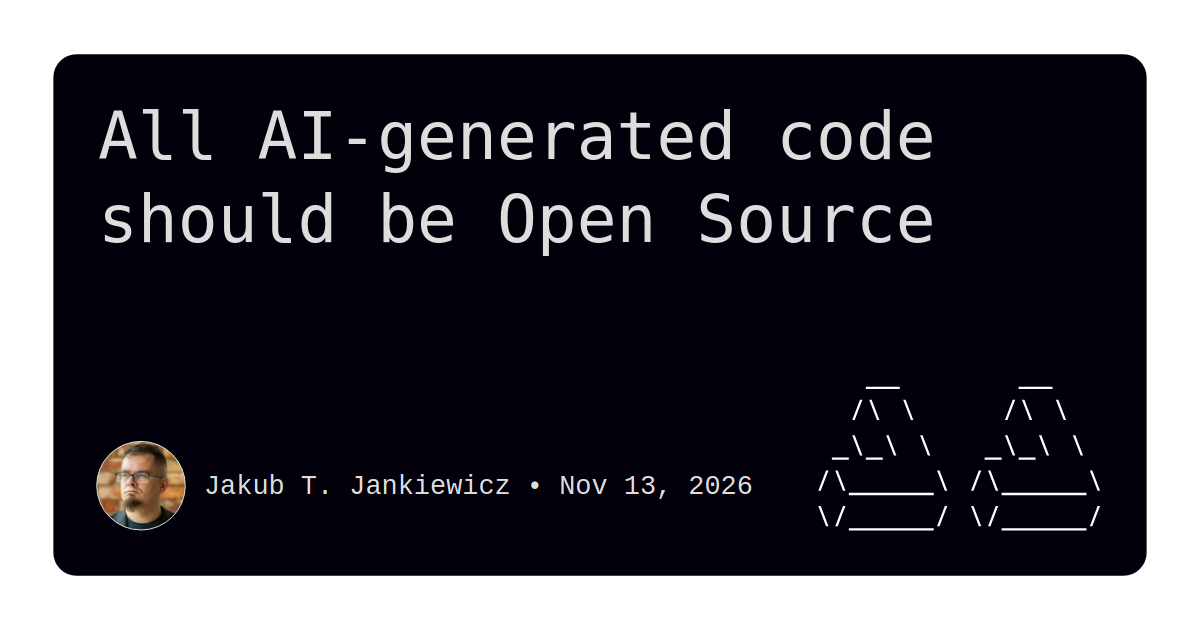
The core claim in the linked post is normative rather than legal: because AI models are trained on large bodies of public code and because generated output is often a remix of patterns learned from that corpus, the author argues that releasing AI-assisted code openly is the fair counterpart to that debt.
It is worth separating two ideas that often get merged in these discussions. One is whether model output is legally derivative of training data, which is a question for courts and license lawyers. The other is whether developers should voluntarily open their AI-assisted work as a matter of norms. The post is making the second argument, and the Hacker News thread reportedly shows how far apart readers are on it.
Why developers are split
Commenters raised the obvious counterpoint: a human writing code after reading open source libraries does not owe the world a license on their output, and many see AI assistance as a faster version of the same process. Others argued the scale is different, since a model can reproduce recognizable fragments of training code without the developer ever seeing the original.
A third camp focused on practicalities. Even if you accept the ethical argument, there is no reliable way today to determine how much of a given function came from a model versus from the developer, which makes any blanket rule hard to apply consistently across a codebase.
What this means for teams building on LLM APIs
For teams shipping products on top of hosted model APIs, the immediate takeaway is governance rather than philosophy. Track which parts of your codebase were model-assisted, keep prompts and model versions alongside commits where practical, and be deliberate about which repositories are public and which are not.
Licensing hygiene matters too. If your product depends on permissively licensed open source, an internal policy on AI-assisted contributions helps you answer customer security questionnaires and due diligence requests later. None of this requires adopting the post's position, but it does require knowing your own provenance story.
Vendor-neutral point: the obligations you carry depend on the terms of the model provider you use and the licenses of the code you feed in, not on the model family itself. Read both before you assume a default.
The provenance gap is the real bottleneck
The strongest practical objection in the thread is that nobody can measure compliance with a rule like this. Watermarking generated code, tracking model lineage per line, and attributing fragments back to source repositories are all active research areas, not solved products.
Until that changes, expect this to remain a norms debate rather than a compliance regime. Teams that want to be ahead of it can start by documenting their AI usage internally, which is useful regardless of how the licensing question resolves.
Частые вопросы
Does this post change any license obligations for my AI-generated code?
Should I open source everything my team builds with AI assistance?
How can I track which code was AI-assisted?
Источники
Вызывайте эти модели через один шлюз
Admesh предоставляет единый API, совместимый с OpenAI: один Base URL и один ключ для Claude, GPT, DeepSeek и других моделей. Новым аккаунтам доступен пробный кредит без срока действия.